

The Hotline — Episode 07
Brand therapy for founders who think in frameworks and doomscroll in tabs.

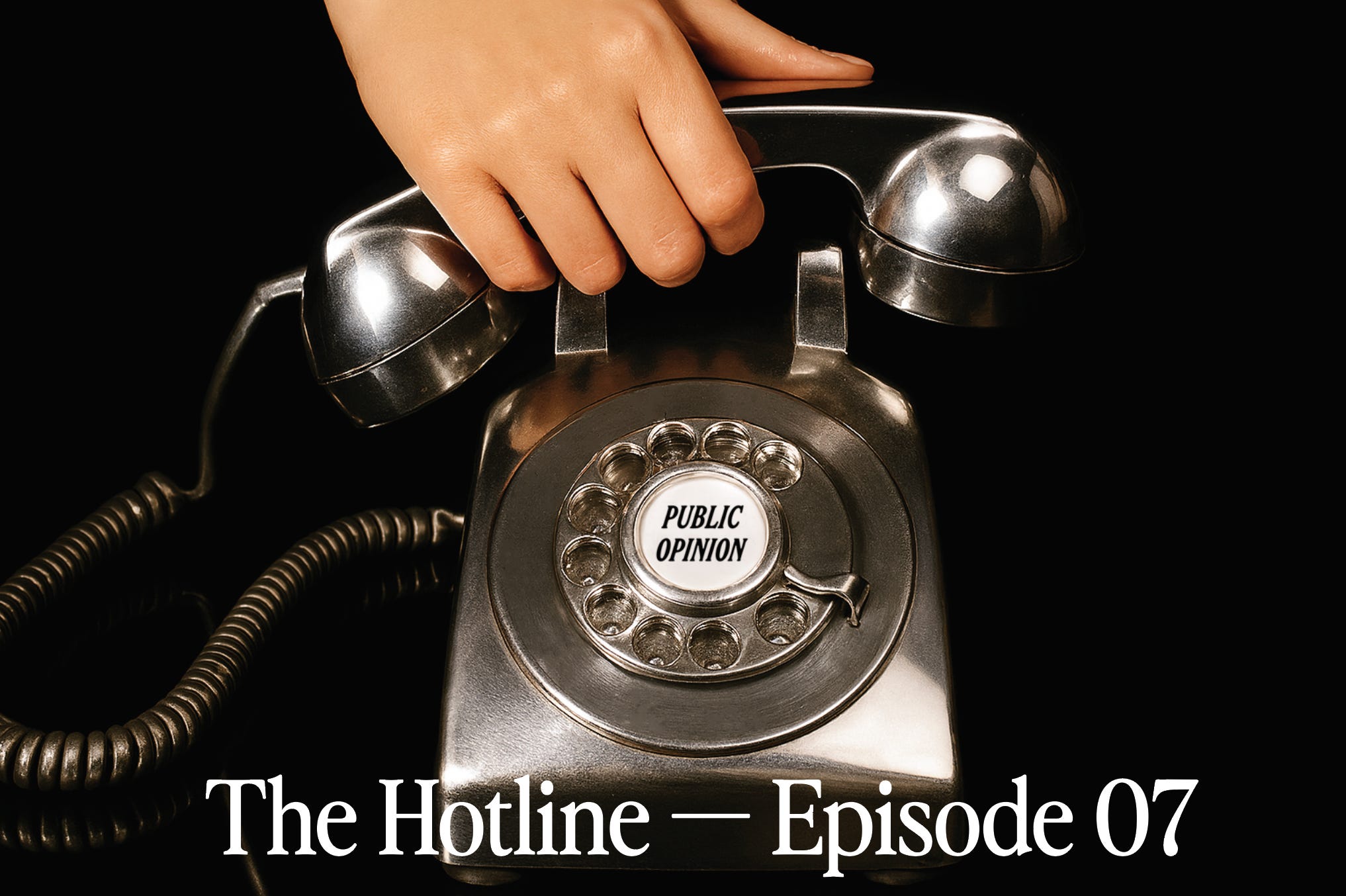
Welcome back to The Hotline; the unofficial survival guide for building a brand in an era where the rules are changing faster than your cortisol levels. You send the questions that haunt your Notes app at 1:11am. We send the clarity, context, and hard truths your group chat won’t.
Drop your next crisis here. Let’s begin.
Q1: If influencing is dead, what are the new “billboards” of the internet? — (Justine M., Brooklyn — Beauty)
Dear Justine,
Influencing isn’t dead, it’s just lost exclusivity. The influence graph flattened. Attention got redistributed. The old “creator → audience → purchase” funnel now looks more like a constellation than a pipeline.
What is dead is dependence on personal brands as your primary growth strategy. The internet has new billboards, and they’re not people, they’re places, formats, and behaviours.
Here are the new front-row attention placements:
1. ChatGPT as a purchasing oracle.
We’ve quietly entered the era where people ask AI what to buy before they ask a friend. “Best prenatal?” “Best running shoes?” “Best retinol?”
ChatGPT has become a meta-influencer; a taste-filter shaped by the collective internet. Not human, but still a billboard. Still a gatekeeper. Still driving behaviour.
2. The rise of the intellectual influencer.
People no longer want aspirational perfection, they want informed perspective. Naturopaths, dermatologists, sommeliers, estheticians, biome scientists, cultural commentators, researchers, critics, economists, thought-explainers…
The new influencers are people who can decode, not perform. Their currency is context, not selfies.
In fact, in my other business, Land Lab, our category is already living this shift. Our most trusted advocates aren’t lifestyle creators, they’re health practitioners who speak with authority, nuance, and actual clinical reasoning. Their influence comes from being well-regarded and ruthlessly honest, and our community trusts them because they have nothing to gain from overselling.
3. Micro-communities, not mega-audiences.
The new billboards aren’t public; they’re private. Group chats, Discord channels, close-friends lists, micro-niche Substacks. These quiet pockets of the internet move more product than most paid posts ever will.
4. Search platforms as decision-makers.
TikTok SEO, YouTube explainers, Pinterest boards, Reddit threads. People are letting search results, not spokespeople, filter their options.
5. Functional formats.
Tutorials. POVs. Demonstrations. Evidence. Receipts. The content type has more influence than the content creator.
So no, influencing isn’t dead.
It’s just no longer embodied by the girl with the matcha on your Explore Page.
Influence today is:
AI + authority + micro-sharing + context + proof.
The future belongs to the brands who know how to collaborate with systems of trust, not just people who hold it temporarily.
Love, P.O.
Q2: What’s the one founder habit that instantly levels you up? — (Isaac L., Melbourne — Nutritional product)
Dear Isaac,
Being decisive.
Not fast, not reckless, not caffeinated. Decisive.
Most founders fall into the trap of “micro-deliberation”: lingering too long at 60% certainty, crowd-sourcing validation, half-committing, over-consuming advice, and quietly eroding momentum.
Brands die in the grey zone. They grow in the green or the red; clear yes or clear no.
The founders who scale faster tend to do one thing consistently:
They make the decision with the information they have, not the information they wish they had, or are still waiting for.
Decisiveness compounds into:
Sharper teams
Faster feedback loops
Clearer brand direction
Cleaner operations
Better creative
Higher trust
A decisive founder doesn’t always make the right call. They make the next call, and that’s what keeps the brand moving.
Love, P.O.
Q3: Is it true that if you try to appeal to everyone, you appeal to no one? Because I’m terrified of niching down. — (Priya B., Toronto — Apparel Startup)
